
Nature's Answer to
Wound Care
Chitosan is one of nature's most biocompatible polymers, with a remarkable spectrum of therapeutic properties. Derived from crustacean shells, it acts as a hemostatic, antibacterial, antifungal, anti-viral, and anti-inflammatory agent — accelerating wound healing, protecting skin from infection, and restoring damaged tissue, all through a fully natural mechanism.
Top Chitosan Applications
in Healthcare
Chitosan's unique film-forming, antimicrobial, and biocompatible properties make it a versatile material across wound care, dermatology, and infection management.
Wound Dressings & Films
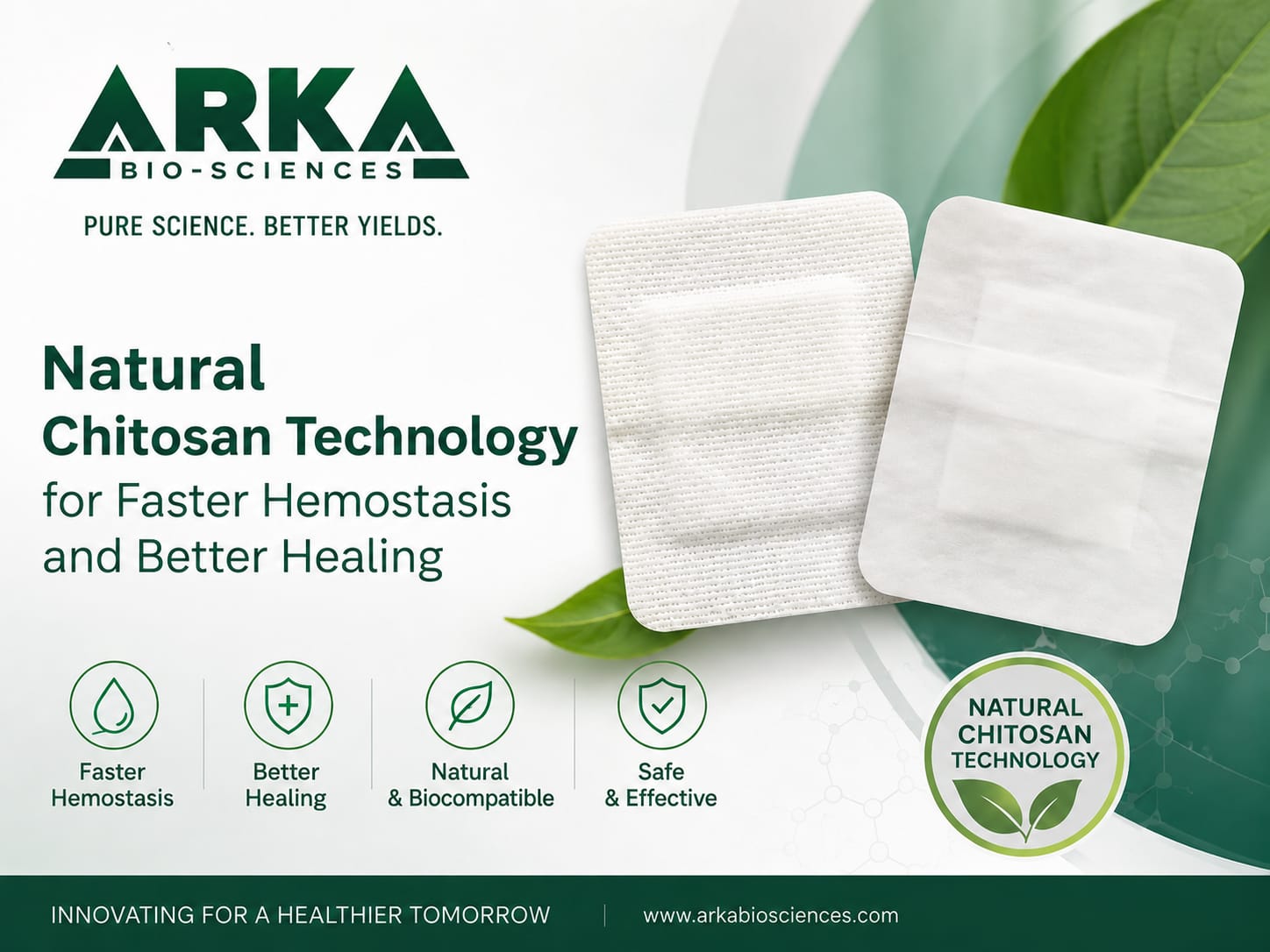
Wound careChitosan's film-forming nature creates a thin, flexible layer over the skin that locks in moisture, blocks bacteria and microbes, and remains permeable to air — accelerating cellular regeneration and dramatically speeding up wound healing without cracking.
Hemostasis & Bleeding Control
Emergency careAs a natural hemostatic agent, chitosan rapidly promotes blood clotting on contact. Its positive charge attracts red blood cells and platelets, making it highly effective in wound dressings and surgical applications requiring rapid bleeding control.
Antibacterial & Antifungal Protection
Infection controlChitosan inhibits bacterial and fungal growth by promoting structural changes in the membrane-wall complex, causing impaired surface cell structure and bacterial death — without the resistance risks associated with conventional antibiotics.
Eczema & Acne Treatment
DermatologyChitosan's film-forming and antimicrobial properties make it highly effective in treating eczema and acne. It reduces infection, delivers antipruritic (anti-itch) and anti-inflammatory relief, prevents scarring, and protects skin from future breakouts.
Tissue Regeneration
Regenerative medicineChitosan promotes cellular and tissue regeneration at the wound site, restoring or replacing damaged tissue. Its biocompatibility means it integrates naturally with the body's healing process, resulting in less scarring and improved cosmetic outcomes.
Chitosan Wound
Healing Properties
A uniquely broad spectrum of natural bioactive properties — all within a single, biocompatible polymer.
Why Choose Chitosan
for Healthcare
Broad-Spectrum Healing
One natural polymer that is hemostatic, antibacterial, antifungal, anti-viral, and anti-inflammatory — covering the full spectrum of wound care needs without multiple synthetic actives.
Natural Antimicrobial Action
Chitosan disrupts microbial cell walls physically rather than chemically, reducing the risk of antibiotic resistance while delivering potent protection against bacteria and fungi.
Breathable Protective Film
Unlike occlusive synthetic dressings, chitosan films are permeable to oxygen and air, facilitating cellular regeneration while keeping the wound site protected and moist.
Reduced Scarring
Chitosan's anti-inflammatory properties and its ability to promote organised tissue regeneration result in significantly less scarring compared to conventional wound dressings.
Biocompatible & Biodegradable
Derived from natural sources, chitosan is fully biocompatible with human tissue and biodegrades safely — making it ideal for medical dressings, topical creams, and skin-contact products.
Clinically Validated
Backed by peer-reviewed studies published in PMC, Nature, and leading biomedical journals, validating chitosan's efficacy in wound healing, dermatology, and infection management.
- 1 Muzzarelli, R.A.A. (2009) — Chitosan-based dietary supplements and wound healing. PMC pmc.ncbi.nlm.nih.gov/articles/PMC6429012/
- 2 Guo, Z., et al. (2021) — Antibacterial mechanisms and applications of chitosan. PMC pmc.ncbi.nlm.nih.gov/articles/PMC7911418/
- 3 Sultankulov, B., et al. (2021) — Progress in the development of chitosan-based biomaterials for wound healing. Nature Scientific Reports nature.com/articles/s41598-021-00100-8
- 4 Hani, U., et al. (2021) — Chitosan as a biocompatible polymer in biomedical applications. PMC pmc.ncbi.nlm.nih.gov/articles/PMC8229754/
- 5 Cheung, R.C.F., et al. (2023) — Chitosan: An Update on Potential Biomedical and Pharmaceutical Applications. PMC pmc.ncbi.nlm.nih.gov/articles/PMC9862721/
- 6 El-Araby, A., et al. (2024) — Chitosan-based nanocomposites: eco-friendly materials for advanced applications. PMC pmc.ncbi.nlm.nih.gov/articles/PMC10794439/
- 7 Sharifi, S., et al. (2023) — Antifungal and antibiofilm activity of chitosan. PMC pmc.ncbi.nlm.nih.gov/articles/PMC9920872/
- 8 Polturak, G., & Aharoni, A. (2023) — Chitosan: Properties and Its Application in Context of Molecular Weight. PMC ncbi.nlm.nih.gov/pmc/articles/PMC10346603/
Interested in Chitosan-based
healthcare solutions?
Talk to our team about wound care, dermatology, and antimicrobial applications for your product or formulation.
Get In Touch →