
Nature's Agrochemical
Alternative
Chitosan is rapidly emerging as one of agriculture's most powerful bio-stimulants. Derived from crustacean shells, it functions across the entire crop cycle — from seed to harvest — enhancing germination, fortifying plant immunity, improving soil biology, and extending post-harvest shelf life, all without synthetic chemicals.
Top Chitosan Applications
in Agriculture
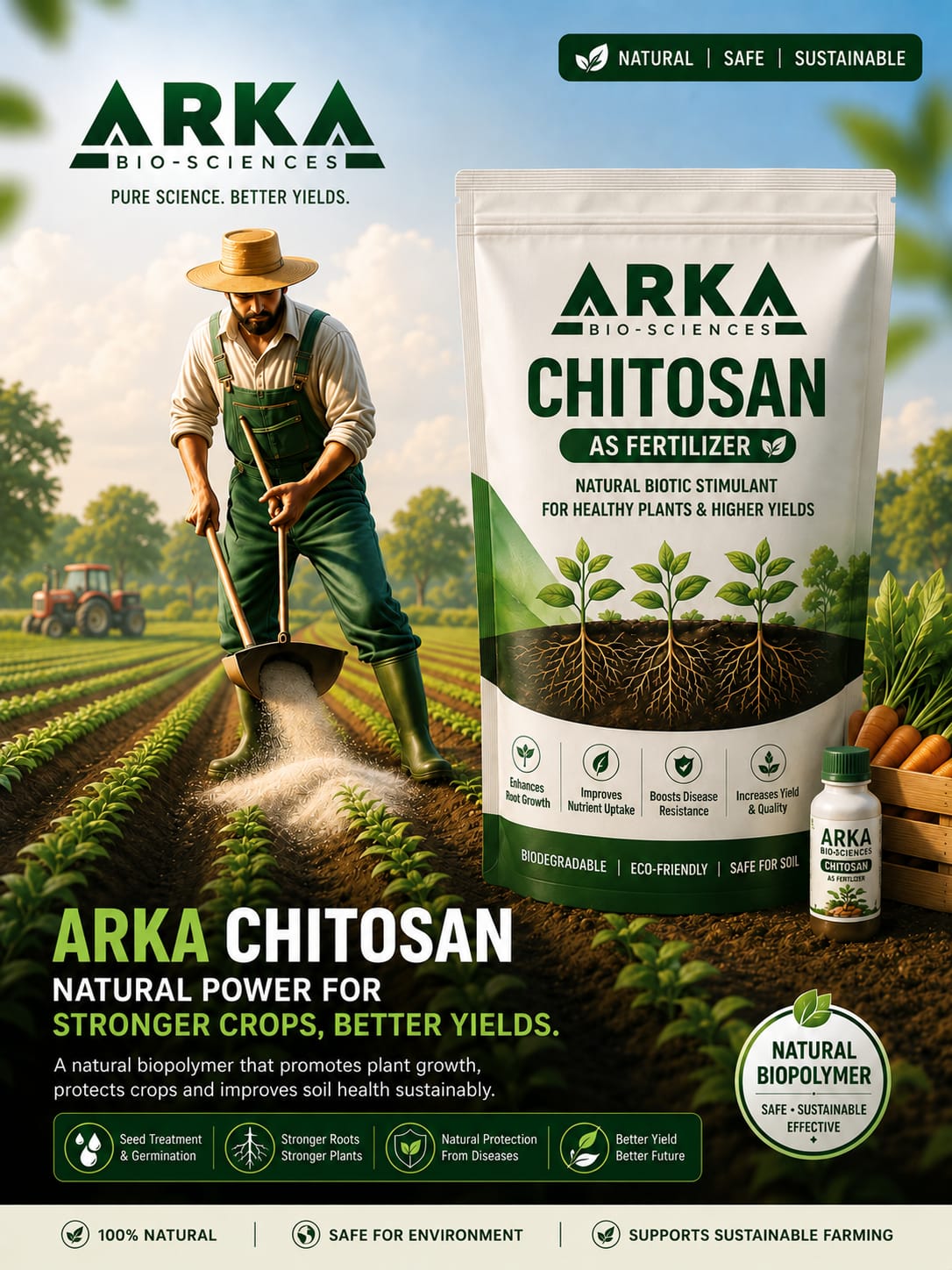
Chitosan works across five stages of the crop cycle, making it one of the most versatile bio-inputs available to modern and regenerative farmers.
Seed Coating
Pre-plantingSeeds coated with low-molecular-weight chitosan germinate faster, show stronger early seedling vigour, and carry built-in disease protection from day one.
Foliar Sprays
Crop protectionSprayed onto leaves, chitosan triggers Induced Systemic Resistance (ISR) — the plant senses it as a fungal signal and fortifies its defenses against pests, powdery mildew, and blight, while also reducing water loss via stomata regulation.
Soil Amendments
Soil healthBlended with soil or biochar, chitosan improves soil structure, enhances water retention, and boosts populations of beneficial microbial communities.
Fertilizer Additives
Nutrient deliveryActing as an encapsulating agent, chitosan creates a slow-release effect for nitrogen, calcium, zinc, and copper — delivering nutrients efficiently over time and reducing environmental runoff.
Post-Harvest Preservation
Shelf-life extensionCoated onto harvested fruits such as strawberries and grapes, chitosan forms a semi-permeable film that slows ripening, prevents moisture loss, and protects against grey mold and microbial decay.
Why Choose Chitosan
for Agriculture
Whole-Cycle Coverage
One bio-input active from seed coating through to post-harvest preservation — reducing the need for multiple agrochemical products.
Natural Disease Resistance
Triggers the plant's own immune response (ISR) rather than relying on chemical pesticides, resulting in more durable, systemic protection.
Reduced Environmental Runoff
Slow-release encapsulation of fertilizers means fewer nutrients leach into waterways, significantly lowering the ecological footprint of intensive farming.
Soil Microbiome Boost
Unlike synthetic soil treatments, chitosan actively feeds beneficial bacteria and fungi, building long-term soil fertility and structure.
Longer Post-Harvest Life
Chitosan-coated produce lasts significantly longer in storage and transit, reducing food waste and improving profitability for growers.
Extensively Researched
Backed by over 10 peer-reviewed studies published in Nature, PMC, and leading agri-science journals validating efficacy across crop types.
- 1 Zhang, X., et al. (2024) — Emerging Nanochitosan for Sustainable Agriculture. PMC pmc.ncbi.nlm.nih.gov/articles/PMC11594357/
- 2 Rojas-Pirela, M., et al. (2024) — Effects of chitosan on plant growth under stress conditions. PMC pmc.ncbi.nlm.nih.gov/articles/PMC11581901/
- 3 Ghasemi Pirbalouti, A., et al. (2025) — Soil-based biochar and foliar-spraying of chitosan enhances yield of yarrow under reduced irrigation. Nature Scientific Reports nature.com/articles/s41598-025-04308-6
- 4 García-Ilizaliturri, E., et al. (2025) — Controlled-Release Phosphorus Fertilizers Manufactured with Chitosan. PMC pmc.ncbi.nlm.nih.gov/articles/PMC11858907/
- 5 El-Araby, A., et al. (2024) — Chitosan-based nanocomposites: eco-friendly materials for advanced applications. PMC pmc.ncbi.nlm.nih.gov/articles/PMC10794439/
- 6 Ahmed, S., et al. (2024) — Nano bio fertilizer capsules for sustainable agriculture. Nature Scientific Reports nature.com/articles/s41598-024-62973-5
- 7 Akram, S., et al. (2025) — A multivariate analysis of seed priming agents and dosage for tomato improvement. PMC pmc.ncbi.nlm.nih.gov/articles/PMC12217798/
- 8 Szopa, D., et al. (2025) — Chitosan-Coated Alginate Matrices with Protein-Based slow-release fertilizers. PMC pmc.ncbi.nlm.nih.gov/articles/PMC11818308/
- 9 Swedan, EA., et al. (2024) — Synergistic effect of nano-potassium and chitosan. PMC pmc.ncbi.nlm.nih.gov/articles/PMC11441042/
- 10 Polturak, G., & Aharoni, A. (2023) — Chitosan: Properties and Its Application in Agriculture in Context of Molecular Weight. PMC ncbi.nlm.nih.gov/pmc/articles/PMC10346603/
Interested in Chitosan-based
agricultural solutions?
Talk to our team about bio-stimulant and crop protection applications for your farm or agri-business.
Get In Touch →